
Guides· ELD & hours of service
Do you actually need an ELD? The 150 air-mile rule, in plain English.
Updated July 17, 2026 · 7 min read
Short answer first: if you run over-the-road — regional or long-haul, sleeping away from home — yes, you almost certainly need an electronic logging device, and the rest of this guide just confirms it. Budget for the subscription and pick a device that's actually on FMCSA's registered list (more on that at the end, because they keep revoking devices).
But if you run local — home every night, working a radius around one yard — there is a real, federal exemption that might mean you never buy an ELD at all. It's not a loophole and it's not a gray area. It's written into the hours-of-service rules at 49 CFR 395.1(e), and plenty of one-truck operations qualify. Here's how it actually works.
The logic behind the whole thing
The ELD mandate never said “every truck needs a logging device.” It said: if you're required to keep records of duty status — the daily driving log — you have to keep them electronically instead of on paper. That's it. So the real question is never “do I need an ELD?” It's “do I need to keep logs at all?” If the answer is no, the ELD question disappears with it.
The big one: the 150 air-mile short-haul exception
If you hold a CDL and run local, this is the exemption that matters. Meet every condition on a given day, and you don't keep a log that day — no ELD, no paper log. A simple time record (start time, end time, total hours) does the job instead.
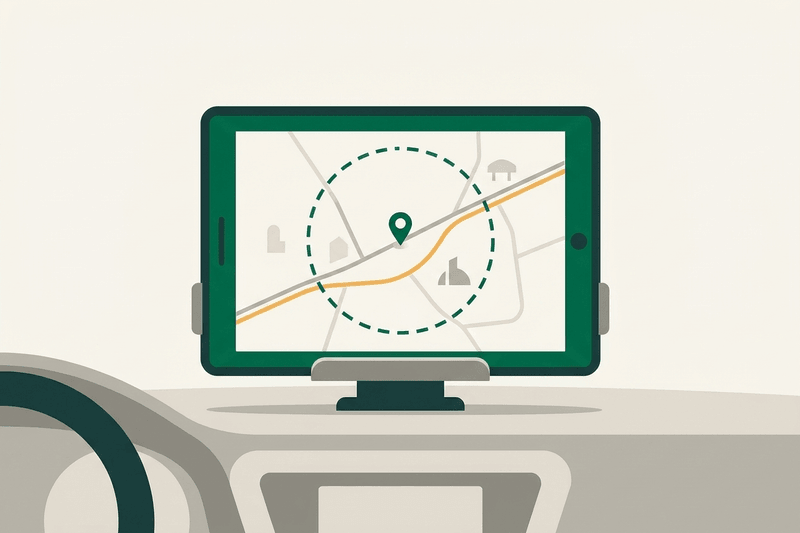
The conditions: all four, every day you claim it — (1) you stay within a 150 air-mile radius of your normal work reporting location, (2) you start and end the day at that same location, (3) you're released from duty within 14 consecutive hours of starting, and (4) you have at least 10 consecutive hours off before the next shift. Keep the time records for six months.
Two details people miss. First, an “air mile” is a nautical mile measured in a straight line from your yard — 150 air-miles is about 172 statute miles as the crow flies, not as your odometer turns. Draw a circle on a map; your actual route miles inside that circle don't matter. Second, it's day by day. Qualifying on Monday says nothing about Tuesday. Each day either meets all four conditions or it doesn't.
There's a matching version for drivers who don't need a CDL for the truck they're driving — same 150 air-mile radius, slightly different hours math (you can't drive after your 14th hour on duty on five days of any week, or after your 16th on two days). If you're running a one-truck CDL operation, the first version is the one you care about.
The day you break the radius
Take a load 200 miles out on a Tuesday, or get back to the yard 15 hours after you started? Nothing bad happens — you just keep a log for that day. A paper log is fine. The exemption isn't revoked; it just doesn't apply to that day.
The trap is doing that too often. The rule of thumb is written as 8 days in any 30: if you need a full log on more than 8 days in any rolling 30-day window, paper stops being allowed and you need an ELD. Count honestly. If your “local” operation drifts over the line a couple times a week, you're an ELD operation that hasn't admitted it yet — and that's exactly the kind of thing a roadside inspection or your new entrant audit will surface. Cheaper to get the device before the citation.
Two narrower exemptions worth knowing
Pre-2000 engines.If the engine in your truck is model year 1999 or older, the truck is exempt from the ELD requirement — the old engines simply don't have the electronic control module an ELD plugs into. The exemption follows the engine, not the title: a glider kit with a 1998 engine under a 2020 body is exempt. But note what this one does and doesn't do — you're excused from the device, not the logs. If your operation requires records of duty status, you keep them on paper.
Driveaway-towaway.If the vehicle you're driving is itself the thing being delivered — hauling a new truck to a dealer by driving it there — that operation is exempt from the ELD requirement. Same catch: paper logs still apply when logs are required.
What no exemption changes: the hours themselves
Every exemption above is about paperwork — how (or whether) you record your hours. None of them touches the hours-of-service limits themselves. The 11-hour driving limit, the 14-hour window, the 70-hour clock: those apply to a short-haul dray and a pre-2000 glider exactly as they apply to an OTR truck with a brand-new ELD. An exemption from logging is not an exemption from the rules the log exists to prove.
If you do need one: check the list before you pay
ELDs aren't certified by the government — manufacturers self-register with FMCSA, and FMCSA removes devices that turn out not to comply. Both lists — registered and revoked — are public and free to check, and devices get revoked regularly enough that it's worth looking before you commit to a subscription. If your device lands on the revoked list, you typically get a short window to replace it, so picking a solid provider up front saves you a scramble later.
Expect to pay roughly $20–40 a month plus hardware for a legitimate device. Anyone selling a “paper log app” as an ELD substitute for an OTR operation is selling you a violation.
Check your ELD against the FMCSA lists — free
Our ELD check looks your device up against FMCSA's registered and revoked lists in about 30 seconds. The lists are public — you could do this yourself on fmcsa.dot.gov — we've just made it fast, and we'll tell you plainly if your device is fine. If you're still sorting out what your first-year deadlines look like, the readiness check covers the rest.
Check my ELDEntrantReady is an independent compliance-readiness service, not affiliated with the FMCSA or any government agency. Anything the government provides for free, we tell you it's free. This guide is general information, not legal advice — requirements can vary by state and operation type. Exemption details verified against 49 CFR 395.1(e) and FMCSA guidance as of July 2026.